
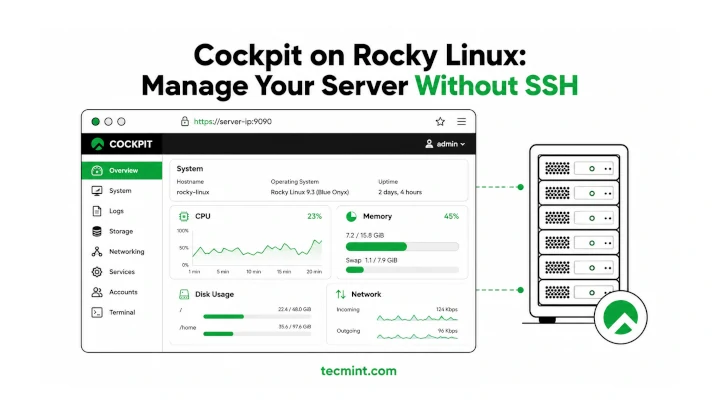
Most people setting up a Rocky Linux server don’t realize that Cockpit is often already available or just a quick install away.
You simply enable the service, open the firewall port (usually 9090), and then log in from your browser using the same username and password you already use for SSH.
Once you’re inside Cockpit, you can manage common server tasks like checking system performance, viewing logs, managing services, and handling storage, all from a clean web interface that is designed to make basic server management much easier, especially if you are new to Linux.
If you need something more powerful for hosting-style control, like managing Apache, MySQL, DNS zones, or running a full control panel setup, then Webmin is worth looking at instead, because it goes much deeper and exposes a lot more system configuration options.
But for a fresh Rocky Linux server, day-to-day management, and getting comfortable with Linux administration, Cockpit is usually the best and simplest place to start.
On Rocky Linux 10, Cockpit is usually available by default, but it’s still a good habit to verify before you try enabling anything.
Open your terminal and run:
If Cockpit is installed, you’ll see output like this:
If instead you see something like:
Then you just need to install it manually.
This pulls Cockpit directly from Rocky Linux’s default repositories, so you don’t need to add any third-party repos or do extra configuration.
Once the installation finishes, you’re ready to enable and start using it.
Cockpit works a bit differently from most services because it uses something called socket activation, which means it does not run all the time. Instead, it waits quietly and only starts when you open the web interface on port 9090.
To enable it and make sure it starts automatically after reboot, run:
Now check if it is running correctly:
You should see output similar to this:
Here’s what this means in plain language:
At this point, Cockpit is running in the background in a “ready but idle” state.
On Rocky Linux, incoming connections are blocked by default for security, which means even if Cockpit is running, you still won’t be able to access it from your browser until you allow it through the firewall.
The good news is that Cockpit already has a predefined firewall service in firewalld, so you don’t need to open a port manually, but just allow the service by name.
Now check if it’s enabled:
You should see something like:
If the cockpit appears in the list, the firewall is correctly configured, and remote access is allowed.
A quick breakdown of what you just did:
If you ever get an error like “FirewallD is not running”, it simply means the firewall service itself is inactive, so start it with:
Then re-run the two firewall commands again.
Now that everything is set up, it’s time to access Cockpit from your browser.
Open your web browser and go to the following url and make sure to replace your-server-ip with the actual IP address of your Rocky Linux server.
The first thing you’ll likely see is a security warning about an untrusted certificate, which happens because Cockpit uses a self-signed SSL certificate by default.
After bypassing the warning, you’ll reach the Cockpit login page, where you can Log in using your normal Linux system credentials (the same username and password you use for SSH).
Once you log in, Cockpit takes you straight to the system overview dashboard, where you’ll see a live summary of your server, including:
Everything is shown in real time, so you can quickly understand how your server is performing without running any terminal commands.
At this point, you’re fully inside the system. From here, you can start managing services, storage, logs, and users directly from the web interface without touching the command line.
Once you’re inside Cockpit, the left sidebar becomes your main control panel. Think of it as a visual version of all the Linux commands you already know, just easier to navigate and harder to break accidentally.
Here are the sections you’ll use most on a fresh Rocky Linux setup.
This is where you manage everything running on your server, so click Services to see all systemd services.
From here you can:
It’s basically a graphical version of systemctl, showing you the same status details but without needing to remember command flags.
Click Storage to see how your disks are being used.
You can view:
This is especially useful when you want to quickly check disk space or confirm if a new drive is detected.
The Networking section shows how your server is connected.
Here you can:
Any change you make here is instantly reflected in firewalld as well, so both tools stay in sync.
Click Logs to access the system journal, where you do not need to type long commands like journalctl -xe, you can:
It’s one of the fastest ways to debug issues when something stops working unexpectedly.
The Terminal tab gives you a full browser-based shell on the server, and it behaves exactly like an SSH session, but inside your browser.
You can:
It’s especially useful for quick tasks where opening a separate SSH client feels unnecessary.
At this point, you essentially have a full graphical control layer on top of your Rocky Linux server, without losing access to the command line when you need it.
Opening port 9090 directly to the internet is not a good idea, as it exposes the Cockpit login to anyone who can reach your server, which increases the risk of brute-force attempts.
A safer and standard approach is to use an SSH tunnel that keeps port 9090 completely closed to the outside world while still letting you use the full web interface.
First, create an SSH tunnel from your local machine.
If you don’t want to keep a terminal window open, you can run the tunnel in the background:
Then open your browser and go to:
What happens here is simple:
This setup is commonly used for securely accessing admin panels without exposing them publicly.
To stop the background tunnel when you’re done:
Replace pid with the process ID shown in the output.
Cockpit is already available on your Rocky Linux server, and setting it up is surprisingly quick. With just a few commands to enable it and a single firewall rule, you get a fully working browser-based management dashboard in under 5 minutes.
It is not meant to replace the terminal, and it does not try to, but instead, it gives you a simple, visual way to handle everyday server tasks.
For things like:
Cockpit is often the fastest and most convenient option right after a fresh install. If you need something more advanced that goes deeper into application-level control, such as managing Apache, MySQL, or DNS zones, then our Webmin guide on Rocky Linux is the next step.
And if you run into any issues or see an error that is not covered here, feel free to ask in the comments, and I’ll help you troubleshoot it.
How to Install Icinga 2 Monitoring Server on Rocky Linux 10
Install Rocky Linux 10 Remotely via RDP on a Headless Server
Create a Self-Signed SSL Certificate for Apache on Rocky Linux 10
Upgrade Rocky Linux 9 to Rocky Linux 10.1
Rocky Linux 10 Minimal Server Installation Guide
How to Install Apache, MySQL/MariaDB and PHP in Linux
Hi, I have some trouble with the web console terminal If I scroll more than 100000 lines it just stops. So I should reset the terminal…
Is there any other way to keep scrolling lines in the terminal?
I need this functionality for my SW demonstration…
If somebody knows how to do it. Please tell me the way to set up..
I’m not receiving email messages from the cockpit after installing and configuring. It performs the auto-updates but no emails.
CoreFreq – A Powerful CPU Monitoring Tool for Linux Systems
Web VMStat: A Real Time System Statistics (Memory, CPU, Processess, etc) Monitoring Tool for Linux
How to Install Icinga2 on RHEL, Rocky and AlmaLinux
Watchman – A File and Directory Watching Tool for Changes
Install Munin (Network Monitoring) in RHEL, CentOS and Fedora
Cockpit – A Powerful Tool to Monitor and Administer Multiple Linux Servers via Browser
Getting Started with Linux Screen Command [20 Useful Examples]
12 Practical Examples of Linux Xargs Command for Beginners
How to Clear BASH Command Line History in Linux
How to Set Static IP Address and Configure Network in Linux
10 Lesser Known Linux Commands That Are Super Useful
How to Christmassify Your Linux Terminal and Shell
8 Best Command-Line/Terminal Email Clients for Linux
27 Best Tools for VMware Administrators in 2024
17 Best KDE Multimedia Applications for Linux
5 Best Open-Source Project Management Tools for Linux in 2024
8 Best Open Source Web Servers in 2024
16 Free and Open Source Video Players for Linux in 2024
—
**📚 Original Source:**
[Cockpit on Rocky Linux 10: Full Server Management Without SSH](https://www.tecmint.com/enable-cockpit-rocky-linux-10/)
About The Author
